01
What Makes Nuts and Trail Mix Difficult to Protect?
One mix can contain oily nuts, moist fruit, sharp seeds, melting chocolate, loose salt, and pieces with very different densities.
We review every component for oxidation, moisture movement, aroma, grease, puncture, heat sensitivity, and settling. The most sensitive component can control the pouch direction.
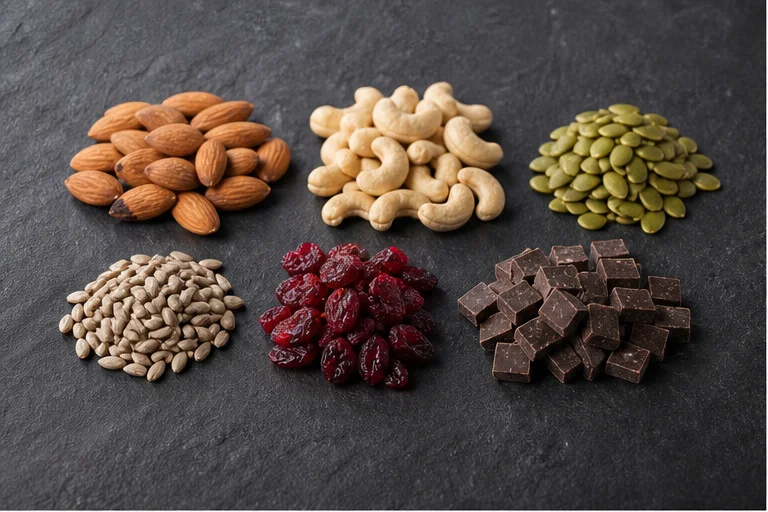
We review the formula before the pouch
We ask for the complete product description, not only the front-label name. Almonds, cashews, seeds, dried berries, chocolate pieces, yogurt coatings, spices, and salt do not behave the same way. Oils can oxidize. Hygroscopic pieces can take up moisture. Dried fruit can hold more moisture than a crisp inclusion. Sharp shells or seeds can press into the film. Fine salt or seasoning can travel toward the zipper and seal.
We also ask whether the recipe changes by season, flavor, or supplier. A new fruit piece or coating can change bulk density, oil level, and heat sensitivity. If one pouch will serve several products, we identify which product represents the hardest reasonable case. We do not call one structure universal without that comparison.
We record the intended distribution and consumer use. A single portion may not need a zipper. A family pouch may open many times. A clear window can show attractive ingredients but can also expose them to light and reduce the opaque barrier area. We map these decisions on the snack food packaging application page and turn them into a product-specific brief. This early work keeps the supplier from guessing what “trail mix packaging” means.
| Mix component | Risk we investigate | Package question |
|---|---|---|
| Nuts and seeds | Oxidation, oils, and sharp points | Barrier, sealant, and puncture direction |
| Dried fruit | Moisture and stickiness | Moisture balance and filling behavior |
| Chocolate or coating | Heat and rubbing | Storage, headspace, and window choice |
02
Which Barrier Direction Fits Nuts?
The phrase “foil bag” can hide the exact laminate, while a clear pack can hide the shelf-life tradeoff.
We compare candidate structures by oxygen, moisture, light, aroma, grease, and puncture needs. We require exact layer direction and test conditions before approval.
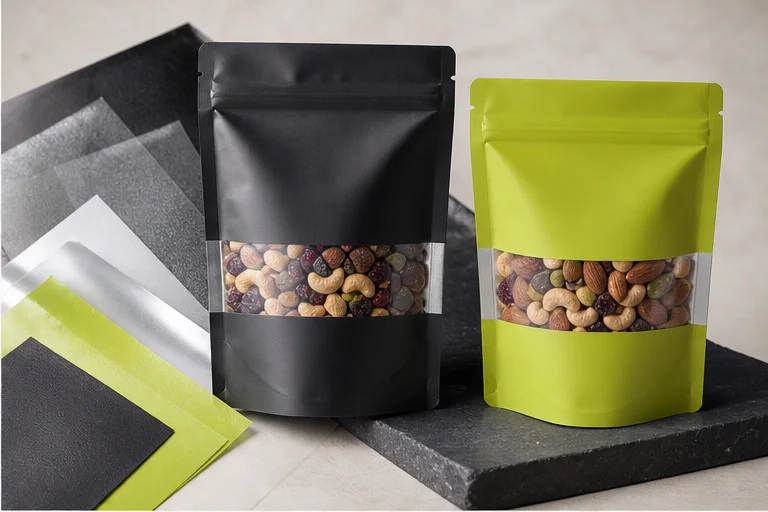
We connect oxidation risk to package evidence
We begin with the product shelf-life protocol. If oxidized flavor is the first failure, oxygen entry and the headspace process become central. If texture changes first, moisture control may matter more. Light exposure can also matter for some formulas and channels. We ask the product team and laboratory to define the failure method and limit. We do not invent a universal OTR or WVTR target.
We then compare actual laminate constructions from outside to inside. We request film and converted-pouch data with test conditions. We examine whether a window, zipper, gusset fold, or seal interrupts the assumed barrier. A metalized direction, foil direction, EVOH direction, or clear high-barrier direction can each have advantages and constraints. The name alone does not prove performance.
We check food-contact status for the intended use. The FDA notes that the regulatory status of a food-contact material depends on the status of its individual components and conditions of use.[1] We request traceable support for the exact structure rather than a broad certificate for a resin family. We keep this work with the stand up pouch material structure guide, and we validate the final choice using real filled product.
| Candidate direction | Question it may address | Evidence we still need |
|---|---|---|
| Opaque barrier structure | Oxygen, moisture, and light control | Exact laminate and filled shelf-life data |
| Clear barrier structure | Product visibility with barrier control | Transmission data and light study |
| Windowed structure | Selective product display | Window material, size, and converted-pack result |
03
How Should the Zipper and Opening Work?
Salt, crumbs, and small seeds can sit in a zipper track and make a premium pouch feel unreliable.
We position and test the zipper for the piece size, serving pattern, pouch width, grip area, and expected contamination. We keep the final seal above a clean zone.
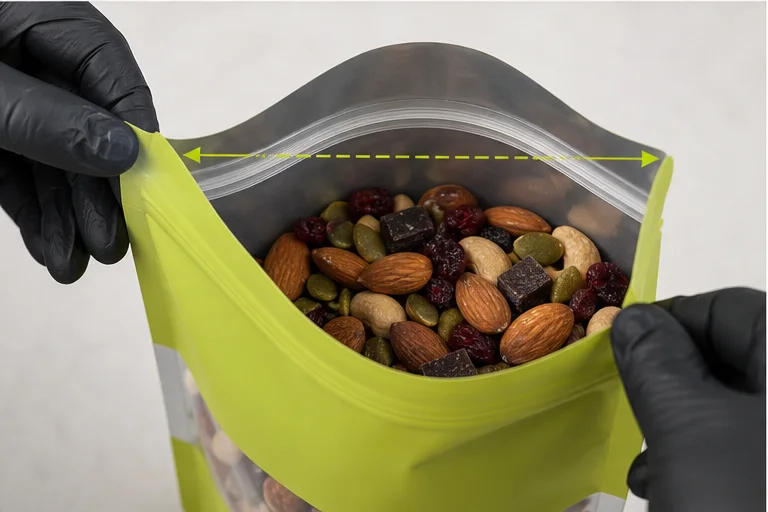
We design for hands and loose ingredients
We ask how people will take the product. Some users pour a portion into a bowl. Others reach into the pouch. A narrow opening can control pouring but make large clusters hard to remove. A wide opening improves access but needs a zipper that engages evenly across the span. We test the chosen width with the actual largest pieces, not an average particle size.
We watch small ingredients too. Salt, chia seeds, crumbs, and powder coatings can settle in the zipper track. We fill pouches through the intended method and close them after realistic contamination. We do not intentionally overload the test, but we do not clean every track like a laboratory sample either. The result shows whether the profile, position, and consumer instruction are practical.
We protect the production seal. The zipper sits below the permanent top seal, and the tear notch must open the header without damaging the reclose feature. The operator or machine needs a clean sealing area. We set the geometry on the custom pouch dieline guide and verify it on finished samples. If the pack uses a hang hole, we also check how that feature affects grip and available header space.
| Opening decision | Trail mix condition | Our test |
|---|---|---|
| Mouth width | Large clusters and hand access | Remove and pour normal portions |
| Zipper profile | Salt, crumbs, and seeds | Repeated closure with real residue |
| Top geometry | Notch, grip, and final seal | First-opening sequence on finished packs |
04
How Do We Run a Filled-Pouch Trial for Trail Mix?
Empty samples cannot show settling, oil marks, sharp-piece pressure, zipper contamination, or the way a mixed product changes during storage.
We fill representative pouches, run the intended seals, pack the real case, and review standing, leakage, puncture, reclosure, appearance, and product quality over time.
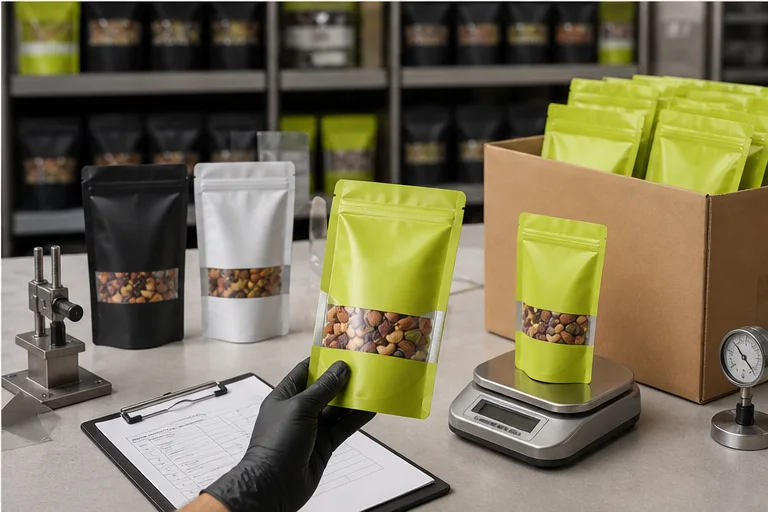
We test every place where the mix touches the package
We fill enough samples to observe normal variation in the mix. One pouch may receive more heavy nuts, while another receives more light fruit. We record the fill weight and settled shape. We inspect whether sharp pieces create pressure points and whether oil or seasoning marks appear near seals or paper-look surfaces. We also check how the bottom gusset opens under an uneven product.
We run the consumer sequence on stored samples. We tear the top, open the zipper, remove a portion, close the track, and repeat according to the intended use pattern. We note product in the zipper, changes in pouch shape, and the remaining product quality. This use trial does not replace the formal shelf-life protocol, but it can expose handling failures early.
We place finished units into the expected shipping case and distribution setup. We look for abrasion between pouches, compression of large pieces, and stress at corners and seals. We keep every observation with the sample revision and production settings. The pouch sample approval guide helps us separate size approval, print approval, and performance approval. We sign off only when the sample represents the exact recipe range, laminate, zipper, seals, and handling route named in the specification.
| Trial stage | Observation | Release question |
|---|---|---|
| Filling | Settling, dust, and seal-zone condition | Can the process repeat cleanly? |
| Storage and use | Quality and zipper handling | Does the pack support the intended use? |
| Case handling | Abrasion, pressure, and breakage | Does the system protect the mix? |
Conclusion
We package nuts and trail mix by defining the hardest ingredient risks, then we prove barrier, opening, seals, and distribution with the real mix.
Sources and further reading
- FDA: Determining the Regulatory Status of Food-Contact Material Components (cited in article)
- ASTM F1249: Water Vapor Transmission Rate Through Plastic Film (further reading)
- Reddit community discussion: Why do some snack bags lack a zipper? (further reading)
Reddit links are community insight only. We use official standards and regulator pages for technical context, and we require project evidence for the final pouch decision.