01
Why Does Fill Weight Not Define Pouch Size?
Two snacks with the same weight can occupy very different volumes, so a weight-only choice often creates a poor fit.
We treat fill weight as one input. We also measure bulk density, piece shape, breakage risk, settling, and the air space needed for filling and sealing.
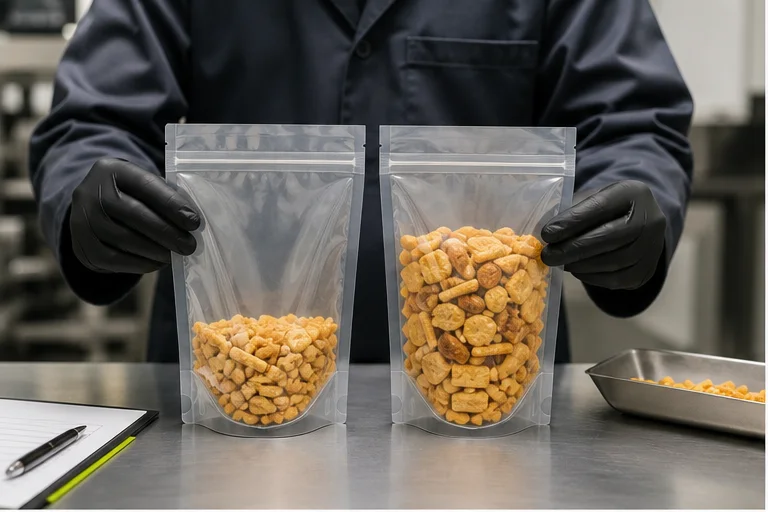
We start with repeated fills
We begin by filling several plain prototypes with the actual snack. We do not use water, rice, or a different product as a final substitute. A light chip, a dense coated nut, and a sticky dried-fruit piece behave differently even when the label shows the same net weight. We record the loose fill height before tapping the pouch. We then record the settled height after normal handling. This range shows how much the product may move before it reaches a shelf. We also watch whether sharp pieces bridge at the opening or press into the sidewalls. Those observations are more useful than a volume conversion alone.
We keep enough space above the product for the filling step, the zipper, and the final top seal. We do not call all empty space waste. Some headspace gives the operator or machine a clean seal zone. Too little space can place crumbs, oil, sugar, or seasoning where the heat seal must form. Too much space can make the pack look underfilled and can let fragile pieces move more during shipping. We therefore test several fill heights rather than chase one theoretical maximum.
We use the result as a starting geometry, not a promise. We still check the filled pouch on its base, in the intended carton, and after representative transport handling. Our detailed stand up pouch size guide explains how we record width, height, and gusset before approval.
| Input we record | Why we need it | What we check |
|---|---|---|
| Target fill weight | It defines the declared pack amount. | We verify the production tolerance separately. |
| Loose and settled volume | It shows the working fill-height range. | We repeat fills with the real snack. |
| Piece shape | It affects bridging and puncture risk. | We inspect corners, coatings, and crumbs. |
02
How Do Width, Height, and Gusset Work Together?
A wider pouch is not always more stable, and a deeper gusset does not always open evenly under a light snack.
We balance face width, usable height, and opened bottom depth. The filled pouch must stand, present the front panel, and leave clear zones for the zipper and top seal.
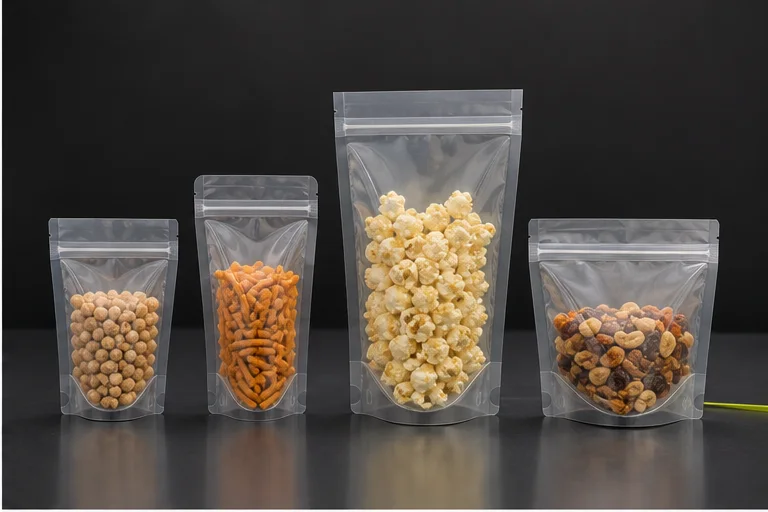
We judge the pouch as a three-dimensional pack
We see many early briefs that list only width and height. We add the bottom gusset because it controls much of the standing base and filled depth. A narrow face with a deep gusset can become bulky and round. A wide face with a shallow gusset can look flat or fall forward when the product settles. The right balance depends on how the snack distributes its weight. We open each prototype fully before filling because a gusset that stays partly folded gives a false capacity result.
We also separate total height from usable fill height. The top area can contain a tear notch, a zipper, a consumer grip zone, and a permanent heat seal. These elements need space between them. If artwork crowds that area, the pack can look fine in a flat proof but fail after the top is trimmed or sealed. We mark every functional line on the approved dieline. We then compare the filled front panel with the flat artwork so the brand name and required information remain readable.
We check shelf behavior after the pouch has rested. Granular snacks may settle into the gusset and create a firm base. Large, light pieces may stay high and leave the base partly empty. We do not assume the pouch will stand because the format is called a stand-up pouch. We confirm it with filled units. We use the custom pouch dieline guide to keep those functional zones visible during artwork review.
| Dimension | Our practical question | Common miss |
|---|---|---|
| Width | Does the front panel fit the product and artwork? | The face becomes too wide after settling. |
| Height | Is there room for fill, zipper, and top seal? | The artwork enters the seal zone. |
| Bottom gusset | Does the base open and support the fill? | The prototype is measured while partly folded. |
03
How Much Headspace Does a Snack Pouch Need?
Too little headspace contaminates seals, while too much headspace can weaken the pack’s visual value and shipping control.
We set headspace from the filling and sealing process. We allow room for product movement, zipper use, gas handling when required, and a clean final seal.
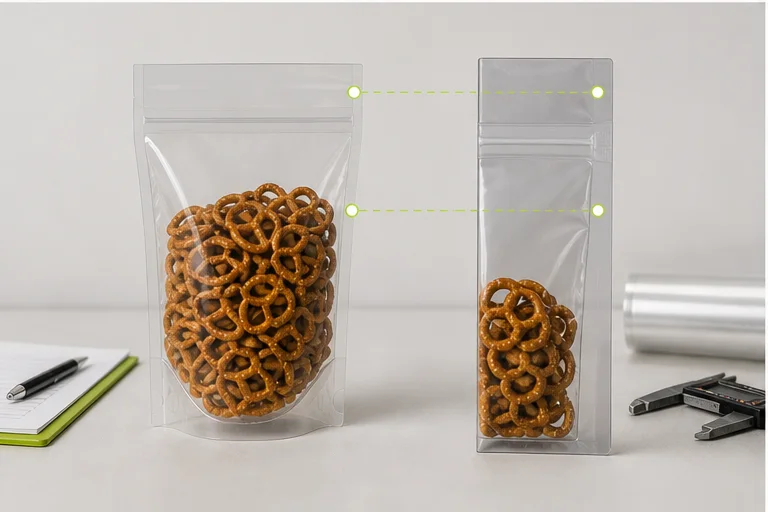
We define headspace as a process zone
We do not use one percentage for every snack. We watch the filling method first. A hand-filled trial may place product gently, while a production filler can drop pieces quickly and carry dust or seasoning upward. We record the highest normal product movement during the real or simulated production step. We then keep the zipper track and the final heat-seal area away from that movement. This approach turns headspace into a controlled process allowance.
We also consider how the consumer opens the pack. The user needs enough material above or around the zipper to grip the pouch after tearing. A tear notch that sits too close to the zipper can make the opening hard to start. A zipper that sits too low can remove useful fill space. A zipper that sits too high can leave little room for the factory seal. We review the entire opening sequence with several people because a flat technical drawing cannot show every handling issue.
Gas requirements can change the decision, but we do not make unsupported assumptions. Some snacks are packed with a controlled headspace gas, and some fragile snacks use headspace to reduce crushing. The actual gas process and target need product-owner confirmation. We record it in the flexible packaging specification checklist and verify it through the agreed shelf-life and distribution work.
| Headspace driver | Evidence we request | Decision it affects |
|---|---|---|
| Filling motion | A production-speed fill observation | Fill line and clean seal zone |
| Opening sequence | Tear and zipper use trial | Notch and zipper position |
| Fragility or gas process | Product-owner process brief | Pack volume and handling |
04
How Do We Approve the Final Snack Pouch Size?
A desk-approved pouch can still lean, burst in a case, hide its barcode, or frustrate a filling operator.
We approve size only after filled-pouch, filling-line, shelf, case-pack, closure, and handling checks use representative product and the intended pouch construction.
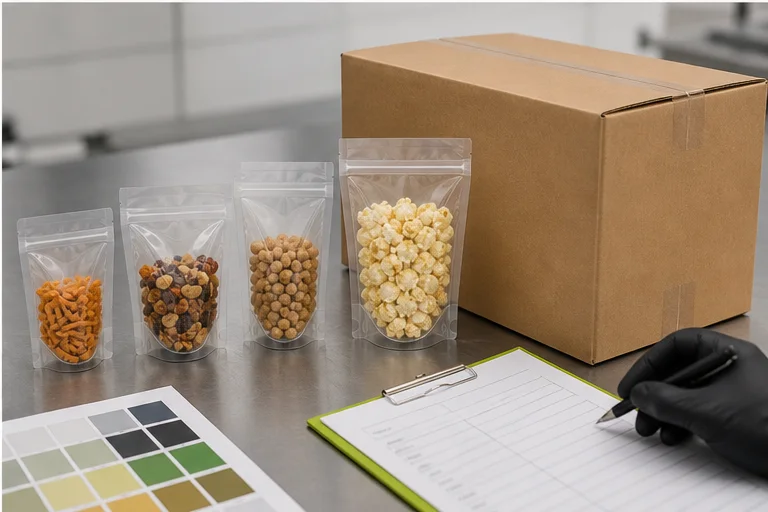
We close the loop with a filled-pack record
We create a simple approval record for each candidate size. We photograph the front, back, side, and base after filling. We note the fill weight, loose height, settled height, and remaining top clearance. We also note whether the base opens evenly and whether the pack stands after several normal pick-and-place cycles. These records make the decision easier to repeat and explain.
We then move beyond the single pouch. We place the intended number of units in the shipping case. We look for wasted space, tight compression, zipper deformation, and rubbing against case edges. We do not approve a larger pouch only because it looks generous on a shelf. A larger flexible pack can move more in transit and can raise carton volume. We also do not approve a smaller pouch only because it uses less film. Tight packs can strain seals and increase filling errors.
The final step is a controlled sample review. We separate what the sample proves from what it does not prove. A plain size prototype can prove geometry and handling. It cannot prove final print color or the performance of a different laminate. A printed empty sample cannot prove filled shelf life. We use the pouch sample approval guide to record those limits. We release the size only when the product owner, filler, artwork owner, and packaging supplier are working from the same revision.
| Approval check | Sample we use | Record we keep |
|---|---|---|
| Shelf presentation | Filled candidate pouch | Front view and standing notes |
| Case fit | Representative packed case | Count, orientation, and movement |
| Production use | Line trial or agreed simulation | Fill and seal observations |
Conclusion
We choose snack pouch size from repeated filled-pack evidence, then we lock the dimensions, functional zones, and approved sample in one controlled specification.
Sources and further reading
- GS1 Package and Product Measurement Standard (further reading)
- FDA: Food Packaging and Other Food-Contact Substances (further reading)
- Reddit community discussion: Better food packaging for less waste (further reading)
Reddit links are community insight only. We use official standards and regulator pages for technical context, and we require project evidence for the final pouch decision.