01
What Is the Main Difference Between the Two Formats?
The visible base is only one difference; the formats also change material flow, seals, graphics, filling, and case packing.
A stand-up pouch uses a bottom gusset to create a display base. A pillow bag forms around the product and usually relies on its contents or a shelf fixture for presentation.
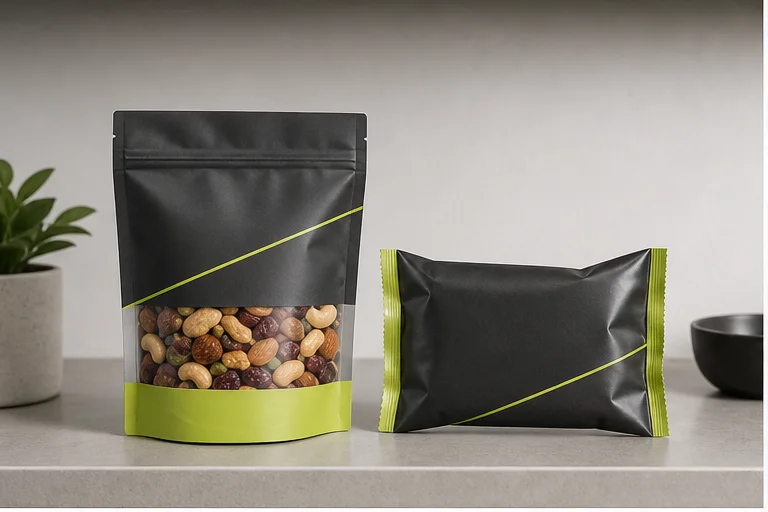
We compare package anatomy before appearance
We start with the seal map. A typical premade stand-up pouch has side seals, a bottom gusset, and an open top that the filler closes. It may also include a zipper and tear notch. A pillow bag commonly has a longitudinal seal and two end seals after the web forms around the snack. The actual construction depends on the machine and supplier, so we confirm the drawing rather than rely on the format name.
That anatomy changes how the pack behaves. The stand-up pouch creates a broad front panel and a base that can support upright display. It can give a small brand a clear billboard on a shelf. The pillow bag can use film efficiently in a high-speed form-fill-seal system, but it may lie, hang, or sit in a tray. It can also protect light, fragile snacks with a loose cushion of headspace. Neither format automatically provides better barrier or stronger seals. Those results come from the laminate, seal design, process settings, and filled product.
We map the consumer action too. If the pack is a single portion, a zipper may add little value. If the pack is opened many times, a reclose feature can support handling. We compare that need with the custom snack pouch with window and the broader product brief before choosing the format.
| Decision area | Stand-up pouch | Pillow bag |
|---|---|---|
| Shelf posture | It can stand on an opened gusset. | It often lies, hangs, or uses a tray. |
| Typical opening | It can combine tear notch and zipper. | It often uses an end-seal opening. |
| Graphics | It offers a stable front panel. | It wraps graphics around a formed pack. |
02
Which Format Fits the Filling Process?
A package that ignores the installed filler can create a costly equipment project before the first sale.
We match the format to the filling route. Premade stand-up pouches and rollstock pillow bags use different feeding, opening, dosing, sealing, and inspection steps.
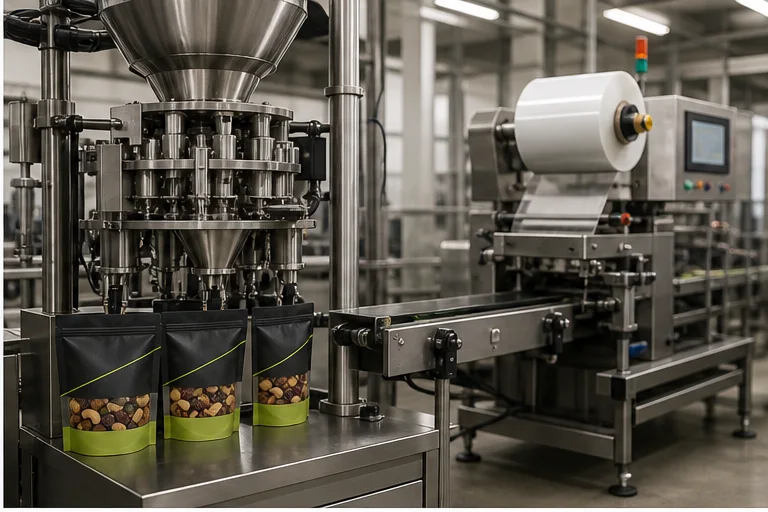
We let the line define practical limits
We ask whether the operation buys premade pouches or forms packs from rollstock. A premade-pouch line must pick, open, hold, fill, and close each pouch. The zipper can add another opening step before filling. The line must keep product out of the final seal area. A pillow-bag line forms film around a tube or product flow and creates the longitudinal and end seals in sequence. Product dimensions, drop distance, line speed, and seal dwell all shape the result.
We do not recommend a format change from a product photo alone. We request the filler make and model, maximum web or pouch dimensions, seal-jaw details, zipper capability, dosing method, and current output pattern. We also ask how rejects are detected. If a co-packer runs the line, we involve that team before artwork and film are locked. A format that the co-packer cannot handle is not a viable design.
We use trials to find the actual constraint. Fragile chips may break under a long drop. Powder seasoning can contaminate a seal. Sticky fruit can bridge at a narrow opening. A zipper can resist pouch opening if its profile and the machine setup do not work together. We record the chosen route in the flexible packaging specification checklist and keep the line-trial revision with the sample approval.
| Line question | Why we ask it | Evidence |
|---|---|---|
| How is the pack supplied? | It separates premade pouch and rollstock routes. | Equipment specification |
| How is product dosed? | It exposes drop, dust, and bridging risks. | Observed fill trial |
| How is the seal checked? | It defines the release control. | Inspection method and record |
03
Which Format Works Better on Shelf and Online?
The retail shelf rewards a front-facing pack, while ecommerce exposes the same pack to repeated compression and rubbing.
We use stand-up pouches for upright presentation when the filled base is stable. We evaluate both formats in the real shelf fixture and the real shipping case.
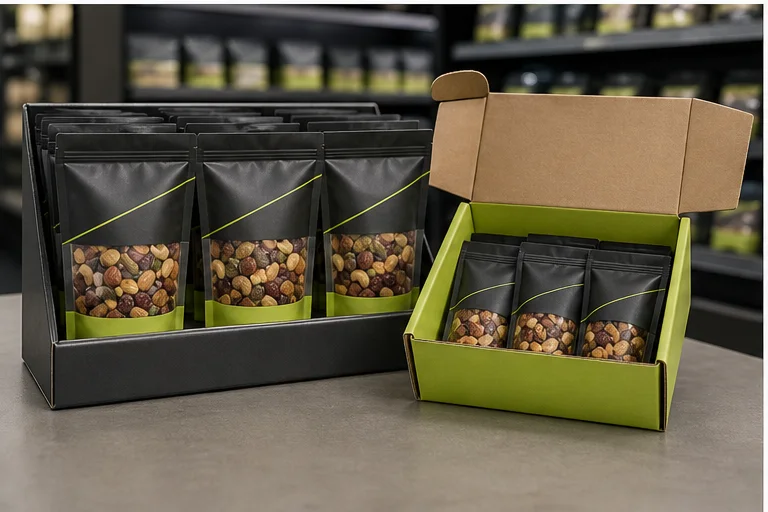
We test the channel, not a perfect render
We place filled samples at the expected shelf height and viewing distance. We check whether the brand, product name, flavor, net contents, and main visual remain visible. A stand-up pouch often gives those elements a steady front panel. The result changes when the pouch slumps, bows, or is overfilled. A pillow bag can work well in a shelf-ready tray or peg display, but its face can change as the product settles. We photograph the actual display because a flat artwork proof hides these effects.
For ecommerce, we pack the pouch with the other items it may ship beside. We look for corner pressure, zipper deformation, abrasion, and trapped air that makes the shipping case inefficient. We check whether the outer carton or mailer carries the main distribution load. We do not claim that one flexible format is ecommerce-ready without this system review.
We also consider consumer storage after opening. A stand-up base can help a sharing-size pack remain upright in a pantry. A pillow bag can be easy to roll and clip. The important point is the use pattern, not a general convenience claim. We connect the result to the snack food packaging application page so the format decision stays tied to texture, oils, moisture, and handling.
| Channel check | What we observe | Why it matters |
|---|---|---|
| Retail shelf | Front visibility and standing behavior | The pack must present the product. |
| Shelf-ready tray | Fit, removal, and refill | The secondary pack affects display. |
| Ecommerce case | Compression, rubbing, and empty volume | Distribution can change the pouch. |
04
How Do We Make the Final Format Decision?
A format scorecard prevents one attractive feature from hiding filling, seal, cost, or distribution risk.
We score each format against product protection, line fit, consumer use, display, distribution, artwork, and test evidence. We approve the option with the clearest complete system.
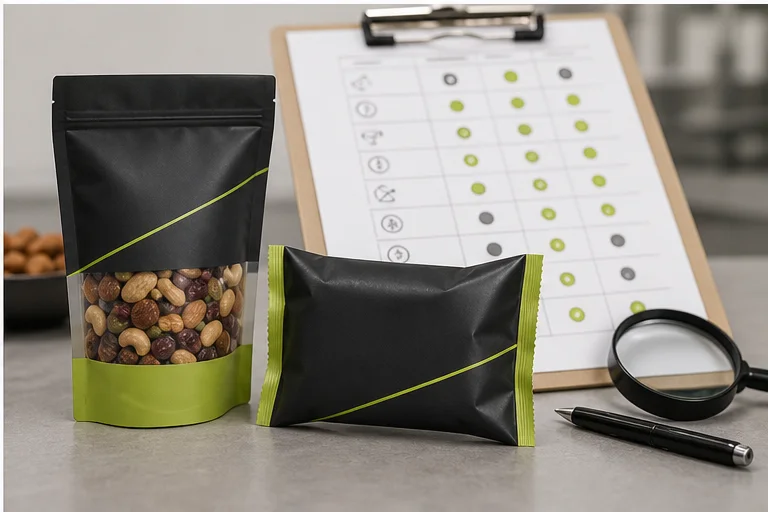
We compare evidence on one page
We build a short decision table before we ask for a commercial quote. We list every must-have and mark the source of evidence. A must-have may be line compatibility, a resealable opening, a specific shelf fixture, or a case count. We keep preferences such as matte feel or a large window in a separate group. This split prevents a visual preference from overruling a production requirement.
We then compare the unknowns. One format may look stronger because its supplier answered more questions. That does not prove it performs better. We request equivalent data and equivalent samples. We compare material direction, dimensions, sealing approach, feature position, print route, test conditions, and approval scope. We also confirm which commercial points remain outside the technical review.
Our final recommendation can still be conditional. We may select the stand-up pouch if the premade-pouch line trial confirms opening and clean seals. We may select the pillow bag if the rollstock trial protects the snack and the shelf tray holds the graphic correctly. A conditional decision is more honest than a universal claim. We document it in the pouch sample approval guide and do not release production until the named evidence is complete.
| Scorecard group | Example must-have | Pass evidence |
|---|---|---|
| Product and barrier | The snack meets its defined quality window. | Shelf-life protocol and results |
| Operations | The pack runs on the selected line. | Representative line trial |
| Channel | The pack survives its distribution system. | Case and handling review |
Conclusion
We select the format that works as one product, line, shelf, shipping, and consumer system, then we document every condition that still needs proof.
Sources and further reading
- GS1 Package and Product Measurement Standard (further reading)
- FDA: Food Packaging and Other Food-Contact Substances (further reading)
- Reddit community discussion: Why do some snack bags lack a zipper? (further reading)
Reddit links are community insight only. We use official standards and regulator pages for technical context, and we require project evidence for the final pouch decision.