01
Control incoming identity
Verify material, component, ink/adhesive and revision records before conversion. At incoming inspection, confirm the material and component identity against the current specification before production begins. Keep supplier documents, lot references, artwork revision and any approved substitutions together. A label match alone does not show that every performance claim is supported, so note which documents are still needed. If a mismatch appears, identify the affected stock and responsible reviewer before it enters printing or conversion. The first checkpoint protects the traceability of every later test.
02
Inspect process-specific outputs
Printing, lamination, slitting, seals, zipper, window and dimensions need named checks at relevant stages. Each production stage needs the checks relevant to its output. Printing review covers the approved artwork and appearance; conversion review covers dimensions, seals and applied features; the filler must separately review product contamination and the final top seal. Set the sample method and acceptance basis before the run, then record results by lot and revision. A finished-pouch appearance check cannot replace the filled-pack checks that depend on the customer’s equipment and product.
03
Add buyer final-seal responsibility
Premade pouch quality does not control the customer’s filling contamination or top-seal settings.
04
Retain traceability
Keep lot, sample, result, nonconformance, disposition and approved change records.
Buyer decision example
Make inspection decisions traceable to the order
Link incoming material checks, print approval, conversion inspection and final filled-pack work to the same order and specification revision. Keep the sample identity, method, condition, result, acceptance criterion and decision owner together. A visual inspection of an empty pouch and an integrity check of a filled package answer different questions.
Agree the sampling plan and treatment of nonconforming material before production. If a defect appears, identify the affected lot, contain it and document the review rather than silently replacing the measurement. Check whether a material, artwork, feature or process change requires further validation. The release record should show which checks passed, which remain open and who accepted the final specification; a checklist tick alone is not a test result.
For a repeat order, compare the current material, artwork, dimensions and closure against the released reference before relying on earlier results. Record substitutions explicitly. Include who can accept a deviation and how affected stock remains identifiable until the disposition is agreed.
At each production stage, specify the item being inspected, how samples are selected, the method, the acceptance basis and where the result is stored. Incoming identity, print registration, laminate condition, dimensions and closure function need different observations. Keep an empty-pouch inspection separate from a filled-pack trial: the latter adds product contact, final top sealing, handling and display conditions that the converter may not control. A checklist is useful only when its entries point to actual records.
Before release, reconcile the order, artwork, material and pouch revisions with the inspection records and retained samples. If a result is outside the agreed basis, identify affected lots, document the disposition and confirm who is authorized to accept a deviation. Do not silently replace a failed sample with a later passing one. For repeat work, decide which checks can rely on the approved reference and which must be repeated because the product, material, process, feature or destination changed.
Keep the sampling plan proportionate to the decision it supports. A print appearance check, a dimension measurement and a seal-integrity check may require different specimens and methods. Record the sample location, lot and equipment state so a result can be investigated later. If the buyer specifies a test method, confirm the specimen and acceptance basis before production rather than discovering after the run that the recorded data cannot answer the question.
The final quality handoff should identify what the converter has released and what the filler still must verify with product in the pouch. Include final top-seal settings, contamination control, gross leak or other agreed checks, case handling and retained sample identity. A signed record of open items is preferable to a blanket “passed QC” label when shelf-life or distribution evidence is still pending.
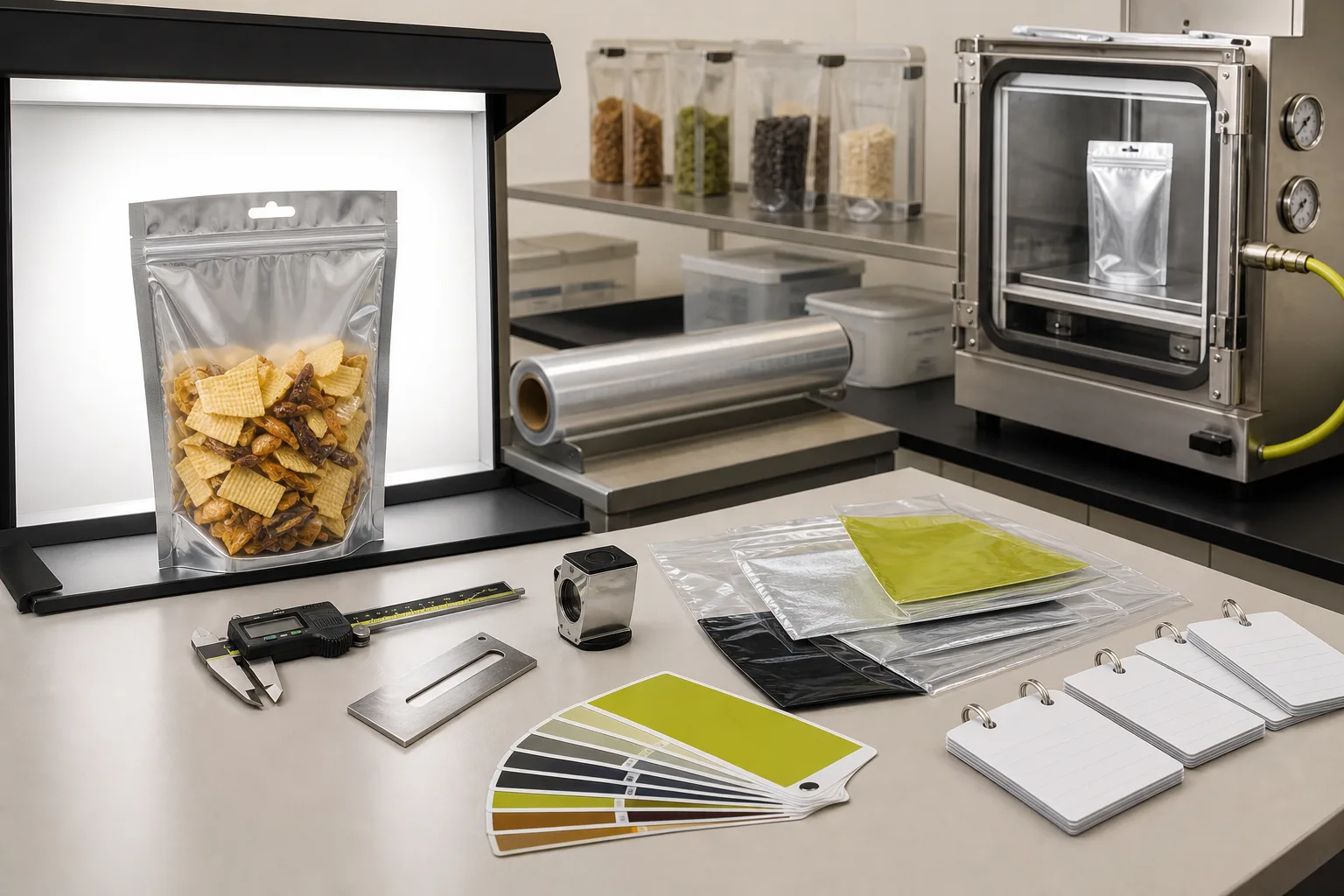
Illustrative review workflow; this is not a reported customer project or test result.
Decision table
Use one normalized record for comparison.
| Stage | Checkpoint | Record |
|---|---|---|
| Incoming | Material/component identity and supporting documents | Lot and specification match |
| Printing | Artwork revision, registration, color reference and defects | Inspection and approval record |
| Lamination/curing | Structure, process and release condition | Batch and curing record |
| Pouch making | Dimensions, seals, zipper/window/notch and appearance | Sampling results by lot |
| Filled pack | Final seal, leaks, opening, handling and display | Project-specific trial record |
| Release | Acceptance, deviations, packing and retained samples | Signed release/change control |
Buyer questions
Direct answers with project boundaries.
What is a universal pouch pass value?
There is none. Acceptance criteria must be defined for the project, method, specimen and use.
Who controls the final top seal?
The filler’s equipment, settings, cleanliness and process are essential; coordinate converter and packer responsibilities.
Does a leak test replace seal-strength testing?
No. They answer different questions and may both be needed within their method scopes.
When should QC be updated?
When product, material, supplier, dimensions, feature, print, equipment, process or acceptance criteria change.