01
Map how contamination reaches the seal
Observe hopper, scoop, chute, product fall, static, dust extraction and operator motions. Observe the actual filling path before designing a seal trial. Crumbs may fall from a chute, powders may travel with air or static, and oil may transfer from product contact. Record the normal fill level and where residue reaches the pouch mouth. A clean hand-sealed empty pouch cannot represent those conditions. Use the observation to choose controlled challenge locations and to identify process changes that might keep product out of the permanent seal zone.
02
Define challenge samples
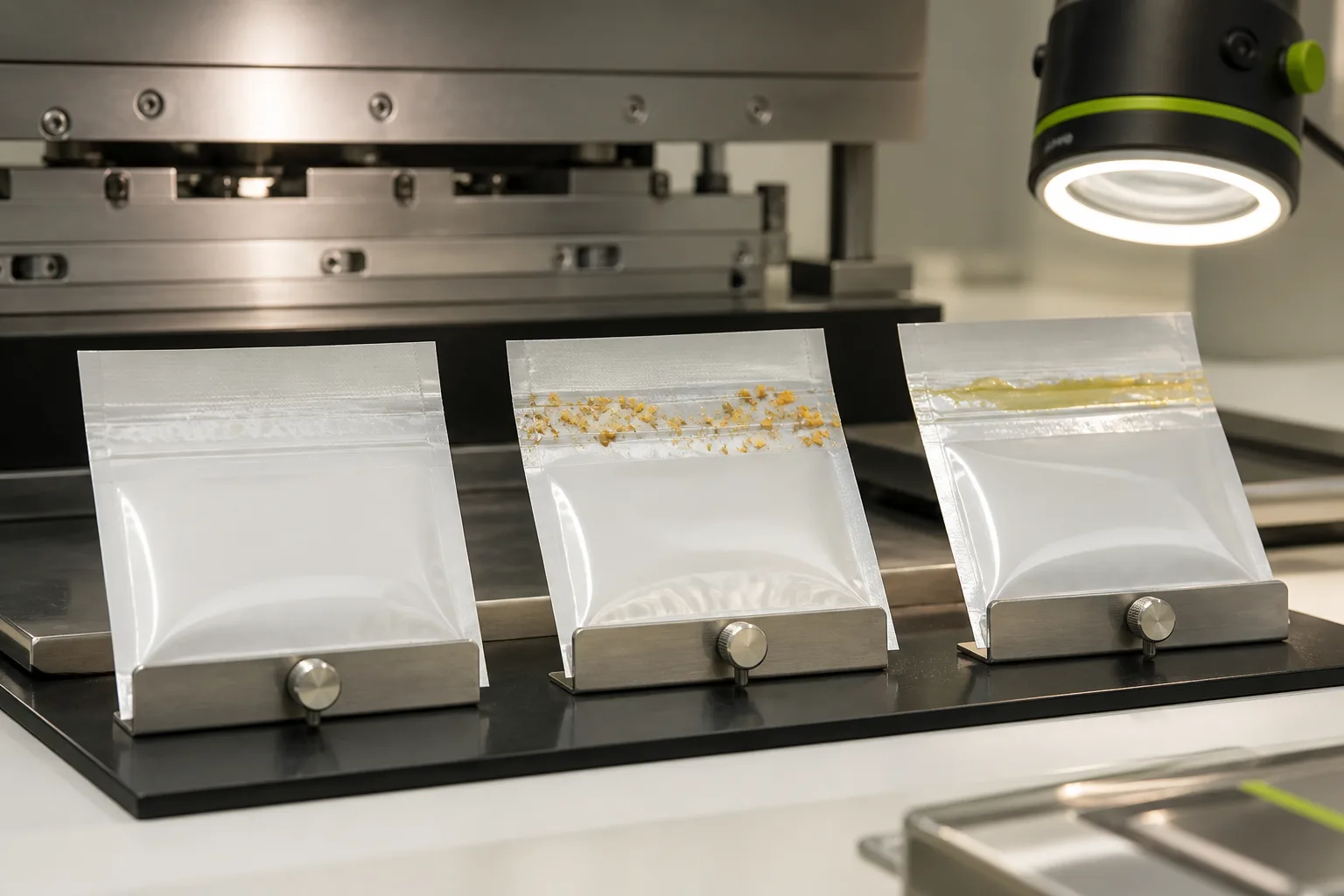
Use visible, repeatable contamination states tied to actual production—not an undocumented handful of crumbs. Prepare a clean control and repeatable challenged groups with named product batches and pouch lots. Describe the contaminant, amount or reference photograph, location and sealing settings for each group. The packer and converter should agree which condition represents normal operation and which represents a plausible upset. Do not mix samples from different settings in one result. That discipline lets the team see whether a material choice or a filling adjustment actually changes the outcome.
03
Control sealing variables
Record temperature, dwell, pressure, line speed, jaw condition and product temperature.
04
Use more than one observation
Visual appearance, seal strength, failure mode, gross leak and filled handling answer different questions.
Buyer decision example
Compare clean seals with realistic contamination
A powder-coated snack can leave residue where the top seal is formed even when empty-pouch trials look acceptable. Keep a clean control group and a separately identified group representing the expected crumbs, powder or oil. Use the same approved material and record the sealing equipment, temperature, dwell and pressure for both groups.
Define with the responsible team how contamination is introduced and how the seals will be assessed; do not invent a universal pass limit. Record visible channels, opening behavior and the selected integrity-test results against sample identifiers. If performance changes, investigate filling clearance, product fall, cleaning and the process window before simply increasing temperature. Repeat the relevant checks on the revised process and retain the decision record.
Photograph the representative seal zone and keep the photograph with the sample label. Record whether a failure occurred through a channel, at an interface or elsewhere in the pouch. Those observations help distinguish a process adjustment from a change to material or filling clearance.
Map the contamination route before setting up the trial. Observe where the product falls, whether fines are created, and which part of the top seal or zipper receives residue. Choose representative clean and challenged samples with the packer and converter, and describe the contaminant location and amount in words or controlled photographs. A random handful of crumbs cannot be repeated reliably. Keep material lot, pouch revision, product batch and equipment settings with each sample group.
Review the outcome with more than a visual pass. Record which samples were opened for strength or failure-mode checks, which were checked for leakage and which were handled as filled packs. The acceptance basis must be agreed for the actual product and method; a strong peel force alone cannot clear a channel leak. If the challenged group fails, change one relevant filling or sealing control at a time, then repeat both the clean comparison and the challenged condition before approving the revised process.
During the trial, keep the fill level and pouch orientation consistent enough to interpret the comparison. Note whether contamination appears before the jaws close or is pulled into the seal by product movement. A change in chute position, dust removal or filling speed may affect the result without any change to the film. Record the change and run a new sample group so the team does not mix two process conditions in one pass count.
The release record should say which contamination states were actually challenged and which were not. If the product formulation or seasoning changes, review whether the previous challenge still represents normal production. Connect any remaining limitation to a monitoring step on the line. This lets the packer and converter agree where their responsibilities meet and avoids treating an empty-pouch seal check as proof of filled-pack integrity.
Illustrative review workflow; this is not a reported customer project or test result.
Decision table
Use one normalized record for comparison.
| Field | Record | Why it matters |
|---|---|---|
| Contaminant | Crumb, powder, salt, sugar, oil or product piece | Different materials interact differently |
| Location/amount | Named seal zone and controlled challenge | Averages can hide weak locations |
| Seal process | Equipment and temperature/dwell/pressure | Changes seal formation |
| Sampling | Clean control, challenge groups, lot and count | Makes comparison traceable |
| Outcome | Visual, force/failure mode, leak and handling | No single test proves all integrity |
Buyer questions
Direct answers with project boundaries.
Can “seal through contamination” be guaranteed?
No generic phrase replaces testing with the actual contaminant, sealant and process.
Should only dirty seals be tested?
Use clean controls and representative challenges so the effect can be interpreted.
Does a strong peel result prove no leaks?
No. Seal strength and leak detection are different measurements.
How can contamination be reduced?
Improve filling clearance, product control, dust/oil management, cleanup and line settings, then confirm with trials.