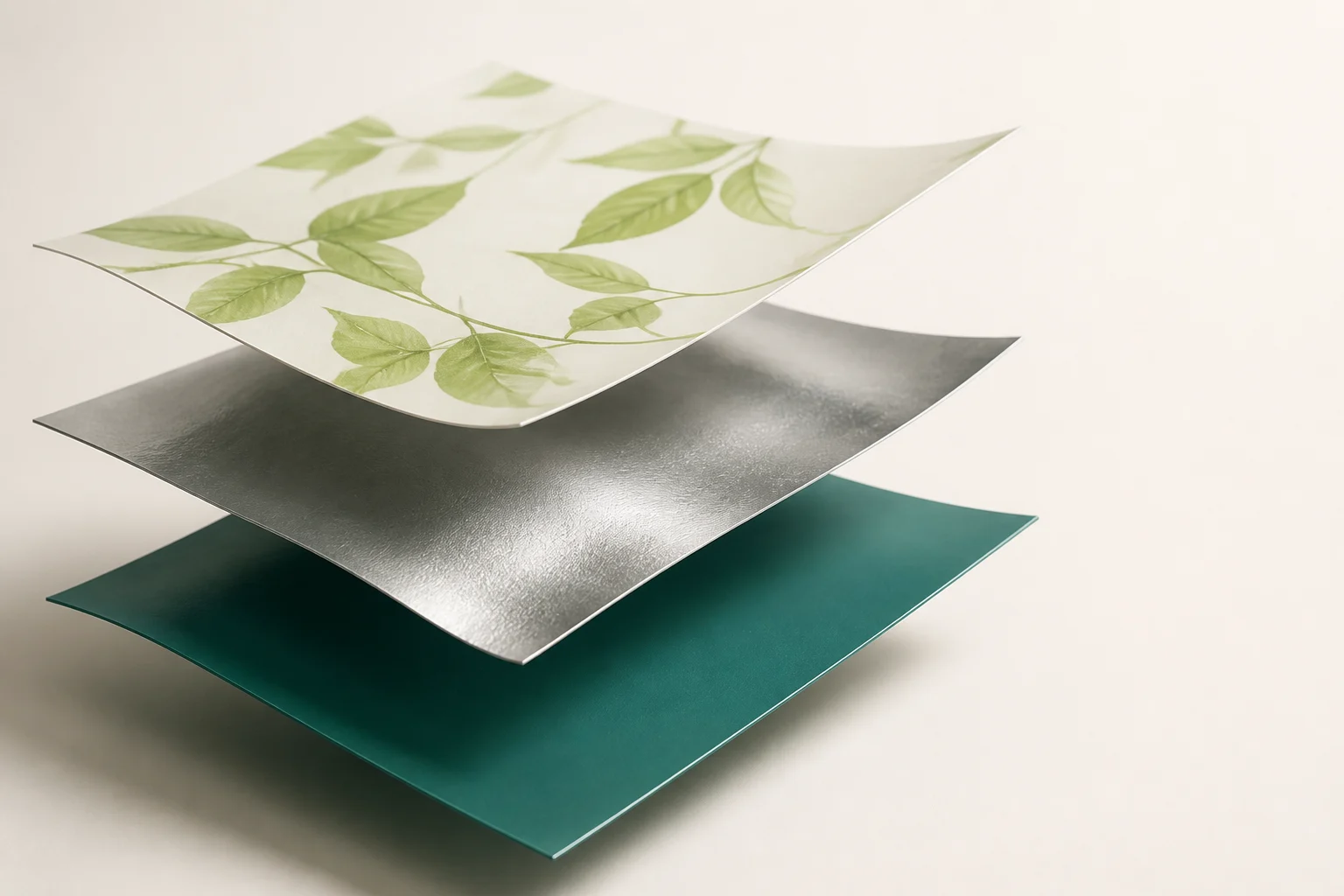
What is a mono-PE pouch?
A mono-PE direction uses polyethylene as the dominant polymer family in the packaging structure. An oriented PE outer web can provide stiffness and print support, with a PE sealant on the product side. Barrier layers, inks, adhesives, coatings and zipper components still form part of the complete package assessment. A resin identification code does not establish that a pouch will be collected or recycled in a particular market.
Compare the structure before comparing claims
| Direction | Buyer decision | Evidence to request |
|---|---|---|
| MDO-PE / PE | Review stiffness, print registration and heat sealing for the intended product. | Layer composition, gauge, seal window, moisture barrier and finished-pouch handling. |
| PE-based structure with a barrier layer | Review oxygen-sensitive products where a simple PE film is insufficient. | Barrier chemistry and weight share, OTR/WVTR conditions, adhesive and zipper compatibility, recycling assessment. |
| PET / VMPET / PE or PET / AL / PE | Retain as comparison candidates when protection requirements remain unresolved. | Matched barrier tests, flex durability and filled storage. Do not label these PE-only structures. |
MDO-PE and BOPE describe different orientation approaches. Do not treat them as interchangeable grades. Likewise, adding EVOH does not make a structure literally 100% polyethylene or automatically qualify it for a collection program.
Barrier performance must be measured on the proposed construction
Request oxygen and water-vapor transmission data with the exact specimen, thickness, temperature, relative humidity, units and test method. Compare candidates under equivalent conditions. A flat-film report does not establish the effect of folds, seals, zipper installation, pinholes or distribution damage on a converted pouch.
For nuts, review oxidation and oil contact; for freeze-dried pieces, prioritize moisture pickup and breakage; for mixed snacks, include each sensitive ingredient. Define the actual shelf-life study before replacing a laminate. No universal OTR, WVTR, seal-strength value or shelf-life duration is published here.
Read the barrier-test evidence checklist · Review freeze-dried snack requirements
Standard stand-up format, project-specific converting trials
The pouch uses front and back faces, side seals and a bottom gusset. A PE-compatible zipper can be assessed for repeat access. Keep the final heat seal separate from the reclosure function. Confirm tear-notch position, print registration, filled standing stability and any window or finish in the approval sample.
Changing to an oriented PE construction can change tension, heat sensitivity and sealing behavior. Run trials on the actual equipment; record jaw temperature, dwell, pressure, cooling, wrinkles and seal failures. Existing-machine compatibility and production speed must be demonstrated for the selected construction.
PPWR and destination-market recycling review
The European Commission states that PPWR rules begin applying in phases from August 12, 2026, with further circular-economy requirements from 2030. The timing and requirements depend on the provision and packaging concerned. Selecting a PE-based laminate alone does not establish PPWR compliance.
Before printing a recycling claim, identify where the finished pouch will be sold, how it is collected, the applicable assessment protocol and the documentation owner. Obtain an assessment covering the complete pack, including zipper, coatings and decoration. Keep food-contact suitability, recyclability and recycled-content claims as separate evidence questions.
For North America, verify current program eligibility and local collection instructions for the specific pack. Do not assume curbside collection or permission to use a How2Recycle label. In Europe, use current design guidance and the applicable assessment route; a design guideline is not a StandPouchy product certificate.
Sources: European Commission: phased PPWR application; Regulation (EU) 2025/40. Reviewed September 21, 2026; check the current text for your packaging and market.
Send a brief that can become an approval record
- Product recipe, oil or moisture sensitivity, fill weight and target shelf life.
- Destination market, intended collection route and proposed on-pack claims.
- Current laminate, dimensions, closure, finish and filling equipment.
- Artwork count, estimated quantity and preferred print route.
- Required food-contact documentation, barrier reports and filled-pack trials.
Digital and gravure routes are reviewed against the actual material and order. Confirm minimum quantity, pricing, sample availability and timing in a written project quote. A pictured pouch or general certificate does not approve a new Mono-PE construction.
Use the RFQ checklist · Compare printing routes · Plan dimensions in the pouch studio
Mono-PE buyer questions
Is every mono-PE pouch recyclable?
No. Complete-pack design, collection, sorting and recycling infrastructure all matter. Obtain market-specific evidence before making a claim.
Can mono-PE replace a foil pouch without testing?
No. Compare the exact constructions and validate sealing, barrier, distribution and storage with the real product.
Are the website compliance reports proof for this material?
Only if their named material, specimen, intended use and conditions cover the proposed construction. Request the specific document scope during review.