01
Read from outside to inside
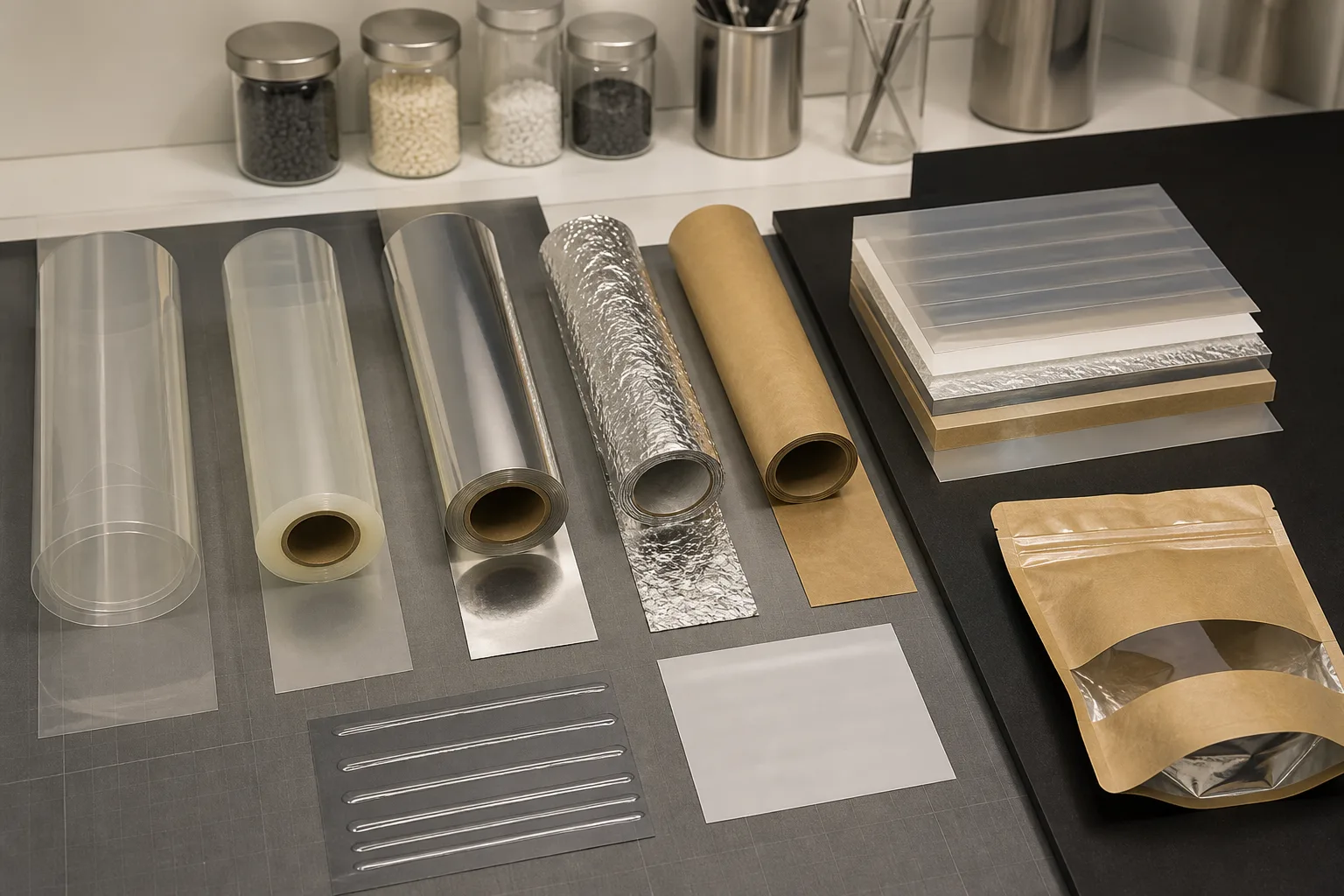
Identify print web, barrier or reinforcement layers, adhesive/coating and product-contact sealant. Read every proposed layer from the printed outside toward the product-contact inside. Ask the supplier to describe each layer’s function and the exact grade and thickness in the project specification. Include coatings, adhesives and inks where they affect the converted structure. A shorthand such as PET/PE can describe a direction for discussion, but it does not identify every property the buyer needs to approve. Keep a named revision with the full layer sequence.
02
Keep appearance separate from function
Matte, kraft-look, metallic and holographic surfaces do not by themselves define barrier or environmental performance. Treat matte, kraft-look and metallic appearances as visual choices to review alongside function, not as evidence of protection. A clear window can require a different local structure from the opaque body. Ask how the two areas meet and which test results apply to each. If the buyer wants a recycling or disposal statement, hold the claim until the complete structure and destination-market evidence have been reviewed. This prevents a visual description from becoming an unsupported environmental assertion.
03
Request exact evidence
Link every claimed function to the proposed material revision and relevant report.
04
Control substitutions
A layer or supplier change can trigger compatibility, barrier, sealing, artwork or shelf-life review.
Buyer decision example
Read the full construction from outside to inside
A layer abbreviation describes a direction, not a complete purchase specification. Identify the outer print web, any barrier layer and the inner sealant, then ask for grades, thicknesses and the ink, adhesive or coating information needed for the intended use. Keep the closure, window and surface finish in the same review.
An opaque foil or metallized layer cannot remain unchanged across a transparent display window. Request the proposed window construction and assess its local barrier and registration. For a PE-family alternative, review the whole pack and destination-market evidence before adding a recycling claim. Compare candidates using equivalent performance conditions and representative filled samples, then record the construction and drawing revision accepted for production.
Create one line per proposed construction showing the outside print web, any barrier layer, adhesive or coating, and inside sealant. Add grade, thickness and supplier reference where available. Then state the job each layer is expected to do and the document that supports it. If two suppliers use the same shorthand label but propose different grades or gauges, treat them as separate candidates. This avoids buying a familiar acronym while the actual sealing or barrier behavior remains unspecified.
Compare the construction against the whole pouch design. Note how the bottom gusset, side seals, zipper, window and print finish will be made, and which of those features changes the evidence needed. Ask for food-contact support applicable to the intended use and market, then plan converted-pouch and filled-product checks. Keep claims about recyclability or disposal outside the specification until the complete structure and destination rules have been reviewed. Record every approved substitution so repeat orders use the same evidence trail.
If a supplier suggests replacing a layer, ask which function changes: print surface, stiffness, barrier, puncture resistance or sealing. A change that appears minor in a short code can affect more than one function. Record the proposed layer sequence and thickness before comparing the new candidate with the approved reference. Request matched data where possible and mark the physical checks that must be repeated on the converted pouch.
Use the library to prepare questions, not to prescribe one laminate for every snack. The product formulation, storage plan, filling process, desired visibility and destination market all affect the shortlist. Give the converter the functional requirements and ask for a project-specific structure with supporting documents. The final release should identify the actual grades and revision so a later order cannot substitute a visually similar material without review.
Illustrative review workflow; this is not a reported customer project or test result.
Decision table
Use one normalized record for comparison.
| Structure direction | Possible role | Decision questions |
|---|---|---|
| PET / PE | Print web plus sealant for selected clear applications | Is transparent protection sufficient under the required conditions? |
| PET / VMPET / PE | Print, metalized barrier/opacity and sealant direction | What exact barrier data, flex and seal evidence supports it? |
| PET / foil / PE | Print, foil barrier and sealant direction | Can conversion and distribution control flex-crack risk? |
| PET / transparent barrier / PE | Visibility with project-specific barrier direction | Which coating/layer, conditions and aging data apply? |
| Kraft / PET / PE direction | Paper-look appearance plus supporting/seal layers | What are the exact layers and which environmental claims are supportable? |
Buyer questions
Direct answers with project boundaries.
Is “Mylar” a complete structure?
No. It is a market term and does not state the actual layer sequence, thickness, barrier or sealant.
Can a kraft-look pouch be called recyclable?
Not from appearance. Environmental claims require the exact structure, market rules and evidence.
Why list adhesive or coating?
Those components are part of the converted laminate and may affect performance, curing, compliance documentation and change control.
How should a substitute be approved?
Document the proposed change, compare evidence and repeat affected printing, sealing, compatibility or shelf-life checks.