01
Separate technical minimum from economic quantity
A line may be able to make a small run while setup waste, cylinders, print preparation or pouch conversion make another quantity more economical. Record both ideas separately. Ask which constraint creates the minimum for the proposed pouch: available film, print setup, conversion setup or a commercial order rule. Record the answer against the exact material, dimensions and number of designs. A supplier may be technically able to make fewer pouches while charging for a larger economic run; those are different decisions for the buyer. Keep the quantity per artwork beside the combined order total so a mixed-flavor launch does not conceal an impractical SKU split.
02
Compare digital and gravure scope
Digital printing can reduce some conventional setup steps for suitable projects; gravure uses cylinders and may suit repeat volume. Material availability, pouch size, colors, finishes and converter capability still set project limits. Request two matched route proposals only when both can meet the same product and pouch brief. State the intended laminate, dimensions, closure, finish and quantity by design in each request. Then compare proof type, setup, approved artwork changes and repeat-order terms. If one route requires a different material or finish, list that as a technical alternative and recheck the filled sample. The comparison is useful only when the buyer can see which scope item caused the quantity difference.
03
Control design and SKU count
Ten designs at one total quantity are not equivalent to one design. Ask how quantity is allocated, whether dimensions and material are shared, and what happens when one SKU changes.
04
Request an auditable quotation
The quote should identify size, structure, thickness, print route, design count, features, packing, freight basis, sample route and validity period.
Buyer decision example
Compare minimums per artwork
A launch brief with several flavors needs a quantity for each artwork, not only a combined order total. Ask whether the quoted minimum applies per design, size, material or converting setup. Shared film and dimensions can simplify the comparison, but do not assume that different artwork files can automatically share one minimum.
Compare a current digital specification with the proposed custom specification using the same fill, closure and finish. Record which requested feature changes eligibility, what sample is included and what remains unpriced. The useful output is a written route and quantity breakdown. If the proposed minimum is too high, review the feature or design split before changing the product-protection requirement.
For each proposed route, write the minimum as a quantity per accepted artwork and per pouch specification. A supplier may combine designs for a commercial offer while still requiring separate print setup, changeover or film allocation. Ask the supplier to identify the controlling constraint and to show what happens if one flavor sells faster than the others. The buyer can then compare a launch order and a repeat order without treating a combined total as stock that can be freely moved between SKUs.
Before reducing a minimum, separate optional presentation choices from requirements that protect or make the product usable. A different finish or fewer artwork versions may change the production scope; removing a necessary seal or barrier question merely transfers risk to the filled pack. Record the accepted alternative, its sample and proof route, the quantity by SKU, any setup charge and the point at which a revised quotation is required. That record makes the next order comparable with the first one.
If a supplier offers a lower-volume path, ask which elements are fixed and which can vary. The pouch size and material may need to be shared across flavors even when the print changes. Capture whether a later reorder can use the same setup, whether obsolete printed stock remains, and who owns any artwork or tooling. These answers help the buyer judge inventory exposure alongside the minimum quantity.
The approval note should distinguish the quantity the brand wants to launch from the quantity the supplier can manufacture under the accepted route. Keep the difference visible rather than changing the forecast to make the quote appear workable. If the gap is material, compare a simpler artwork range, a different print route or a staged launch using the same product-protection brief.
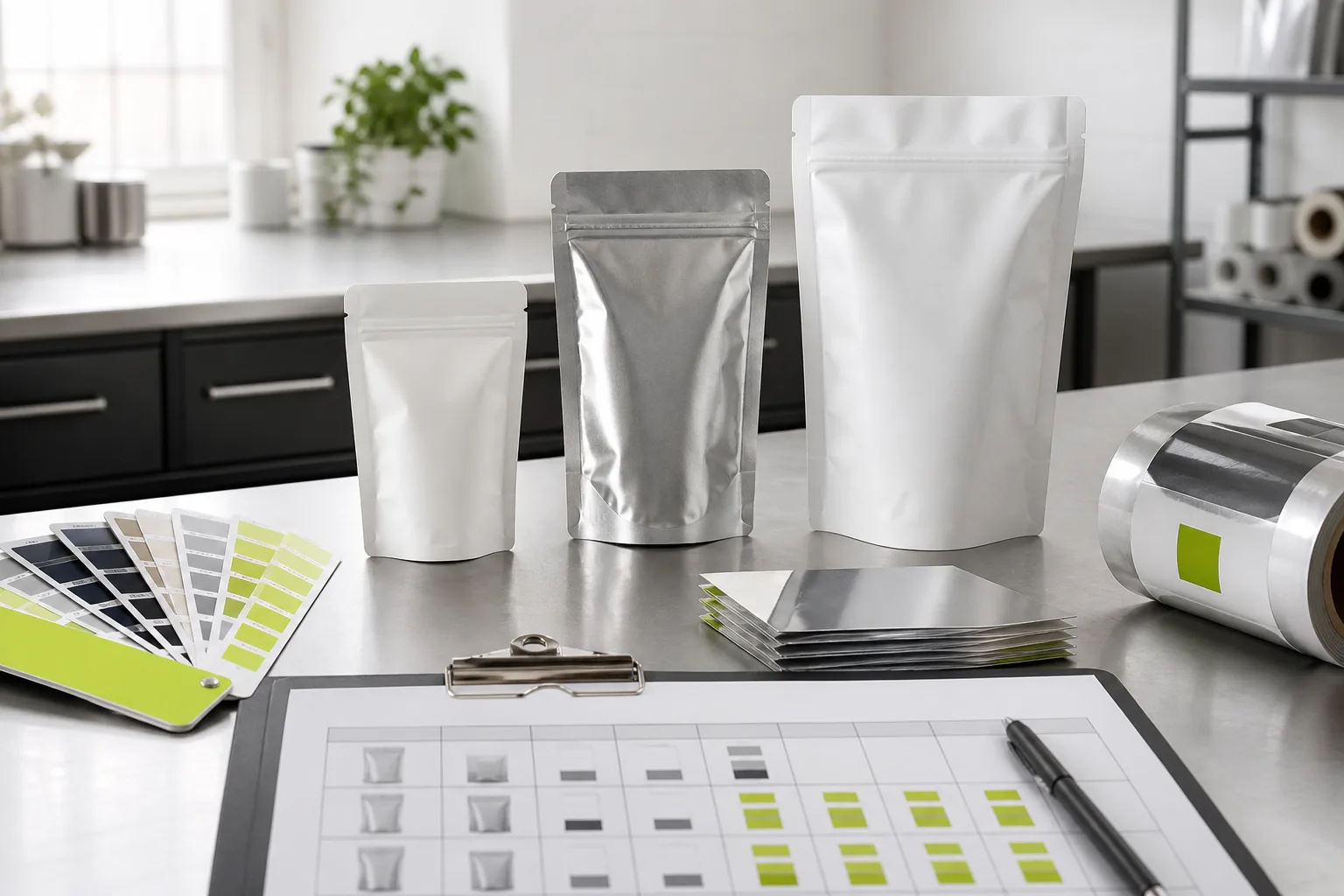
Illustrative review workflow; this is not a reported customer project or test result.
Decision table
Use one normalized record for comparison.
| MOQ driver | What to record | Why it changes the minimum |
|---|---|---|
| Print route | Digital or gravure, colors/effects and approved artwork count | Setup and changeover differ |
| Pouch construction | Size, gusset, zipper, window, valve and finish | Materials and conversion steps differ |
| Material | Exact outside-to-inside structure and thickness | Minimum film run and availability differ |
| SKU split | Quantity per design and shared specifications | Each change can require setup or waste |
| Packing/freight | Carton, pallet and destination basis | Order economics extend beyond pouch count |
Buyer questions
Direct answers with project boundaries.
Can you publish a fixed MOQ?
Not without a confirmed commercial scope. Send the project details for a written MOQ tied to the specification.
Is digital printing always lower MOQ?
It can reduce some setup constraints, but the pouch, film, finish, dimensions and production availability still matter.
Can different designs share one MOQ?
Sometimes, when the technical specification is compatible. Confirm quantity by design and any setup rules in writing.
Should I choose the lowest MOQ?
Compare total scope, unit economics, approval route, repeatability and inventory risk—not the headline number alone.