Coffee & Tea Packaging
Custom Coffee Pouches & Tea Packaging
Plan a coffee or tea pouch around the product form, aroma and moisture risks, fill weight, opening pattern and intended shelf-life review. A valve or zipper is a project choice, not a substitute for confirming the full structure.
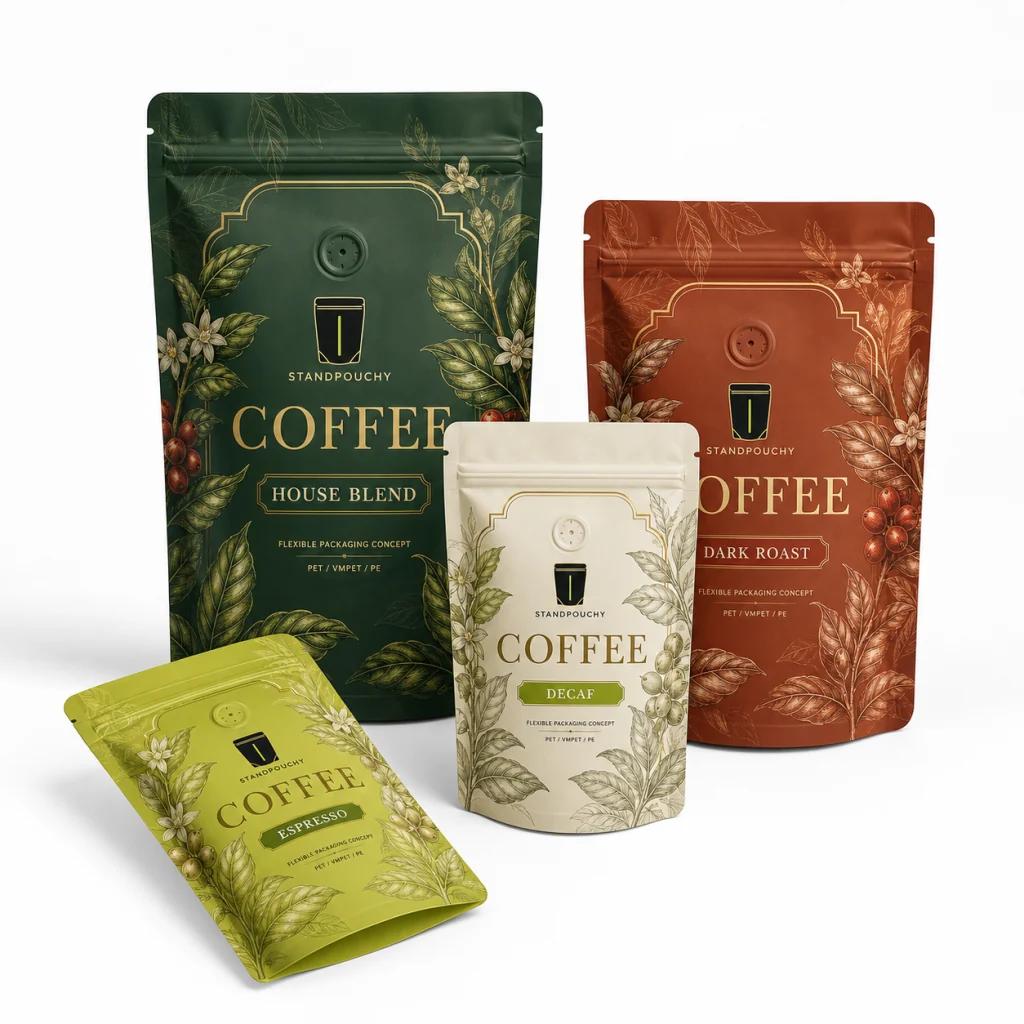
Product risks to define
- Oxygen and moisture exposure
- Aroma retention
- Roast gas for applicable coffee products
- Light exposure and storage conditions
Size and filling inputs
- Whole bean, ground coffee or tea format
- Fill weight and bulk density
- Headspace and filling method
- Valve and zipper clearance
Common pouch directions
- Resealable zipper
- Project-specific one-way valve
- Clear or high-barrier direction
- Matte, gloss or other approved finish
Filled-pack review
- Standing stability
- Closure access after opening
- Seal area cleanliness
- Valve position and packing arrangement
Direct answer
When does a coffee pouch need a degassing valve?
A one-way valve becomes a candidate when the actual roasted coffee is packed while it still releases enough carbon dioxide that pressure or pouch shape must be managed. It is not automatically required for every coffee or tea pouch. Confirm the product, roast and grind timing, pre-pack degassing, headspace, pack atmosphere, distribution conditions and measured filled-pack behavior before specifying it.
Decision record
Build the valve decision from project evidence.
Do not turn “fresh coffee” into an automatic valve instruction. Record the ten fields below, mark unknowns and agree on the evidence that will decide the valve, laminate, headspace and sealing route for this project.
| Decision field | Record for this project | Why it changes the pouch decision | Evidence before approval |
|---|---|---|---|
| Packed product | Whole bean, ground coffee, tea or botanical; product reference | Roasted coffee gas behavior and tea barrier questions are not interchangeable | Representative product and recorded physical form |
| Roast and grind record | Roast date and time, roast reference, grind state and grind time | Carbon dioxide release changes after roasting and grinding | Traceable batch record; do not substitute a generic waiting period |
| Pre-pack degassing | Where, how and for how long the product is held before packing | The remaining gas load depends on the actual product and handling history | Measured or observed gas and pack behavior under the intended process |
| Filling sequence | Product temperature, manual or automated fill, time to final seal | The sequence affects headspace, sealing and the state of the product at closure | Line trial or representative sealing procedure |
| Fill and headspace | Fill weight, bulk density, pouch dimensions and available headspace | The same gas release can affect packs differently when free volume changes | Filled-pouch dimensions, standing stability and pressure or shape review |
| Barrier and pack atmosphere | Laminate revision, OTR/WVTR conditions, air, vacuum or agreed gas route | Valve use does not replace oxygen, moisture and aroma protection decisions | Material results with method and conditions; sealed-pack atmosphere where required |
| Valve specification | Supplier, model or reference, lot, flow direction, location and application method | A valve name alone does not define opening, closing, leakage or attachment behavior | Controlled valve record plus applied-pouch function and leak checks |
| Distribution and storage | Temperature range, altitude or pressure changes, case pack and storage orientation | External conditions can change package pressure, gas movement and handling stress | Agreed distribution simulation or monitored trial conditions |
| After-opening use | Opening size, zipper, expected access pattern and reclosure method | Secondary exposure begins after opening and is a different question from initial degassing | User-access and reclosure review with the intended pouch and product |
| Acceptance and change control | Sample quantity, method, conditions, limits, approvers, date and revision | A valve decision is reusable only while the relevant product and process stay controlled | Signed decision record and defined triggers for revalidation |
Primary research scope
Use the studies to frame questions, not copy targets.
These are primary studies under specific products and experimental conditions. Anderson et al. supports treating degassing as product- and process-dependent, not as a universal waiting time. Smrke et al. supports recording after-opening closure and atmosphere. Kim et al. reinforces that storage conditions affect a valve-pack system. None of the study results is a StandPouchy shelf-life, valve-performance or material claim.
Confirm the specification with the real product.
Confirm the final material structure, valve need and dimensions using the actual product, target shelf life and intended filling process.